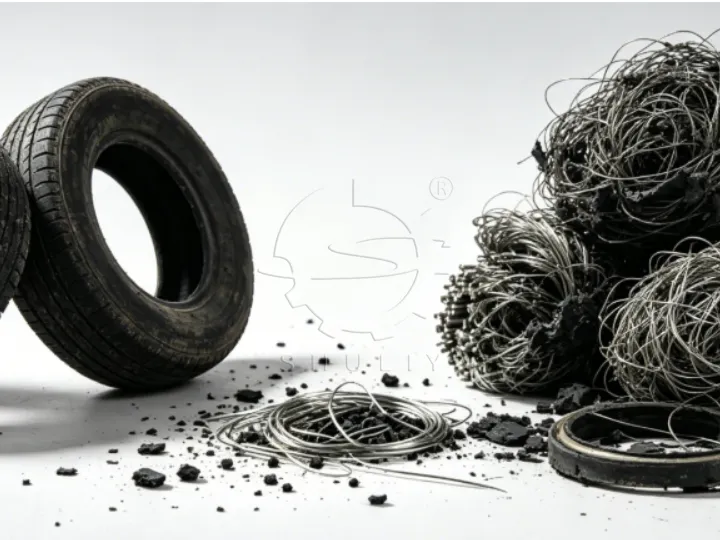
Every year, large numbers of used tires reach the end of their service life. Instead of sending them to landfills or leaving them unused, recycling businesses can process these tires into rubber granules for sports surfaces, rubber flooring, playgrounds, and other applications.
Scrap tire recycling turns discarded tires into reusable materials through a series of mechanical processing steps. The process generally includes tire preparation, shredding, steel wire separation, rubber granulation, fiber removal, and screening.
For investors planning a recycling business, understanding this process is the first step toward choosing suitable equipment and building an efficient production line.
1. What Are Rubber Granules Made From?
Rubber granules are small pieces of recycled rubber produced by processing waste tires. Passenger car tires, truck tires, and other suitable used tires can serve as raw materials, depending on the equipment configuration.
During scrap tire recycling, the tire is gradually reduced in size. Steel wires and textile fibers are separated from the rubber, leaving cleaner rubber particles for further processing or sale.
The final granule size depends on the processing equipment and screening system. Common products include coarse rubber chips and finer rubber granules. If customers require a finer product, additional grinding and screening may be necessary.
2. The Main Steps of Scrap Tire Recycling
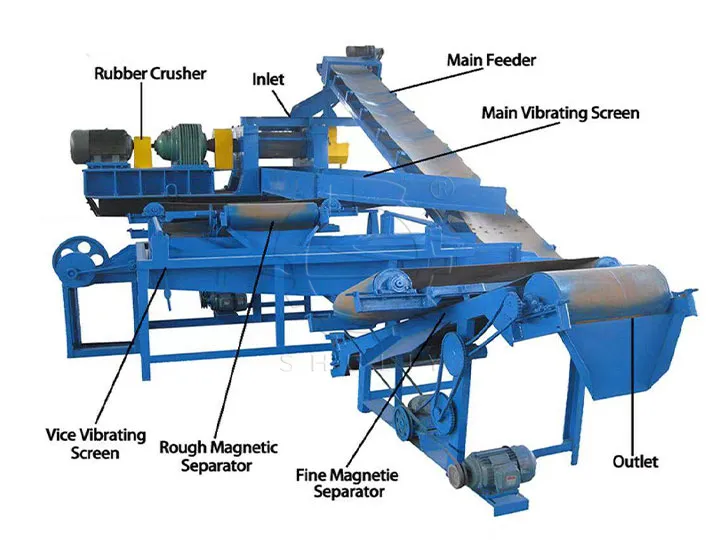
A typical tire recycling line uses several machines to transform whole tires into rubber granules. The exact configuration depends on the raw material, required output size, and production capacity.
Step 1: Tire Preparation
Before shredding, tires may need to be inspected and prepared. Depending on the tire type and production process, bead wire or other components may need to be removed.
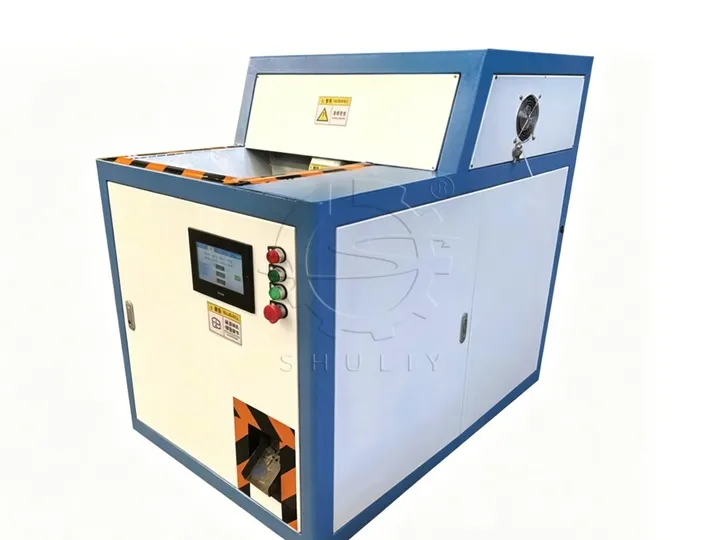
A tire debeader can remove the steel wire from the tire bead. This step is particularly useful in production lines where bead wire removal is part of the selected process.
Proper preparation helps protect downstream equipment and supports smoother material processing.
Step 2: Primary Tire Shredding
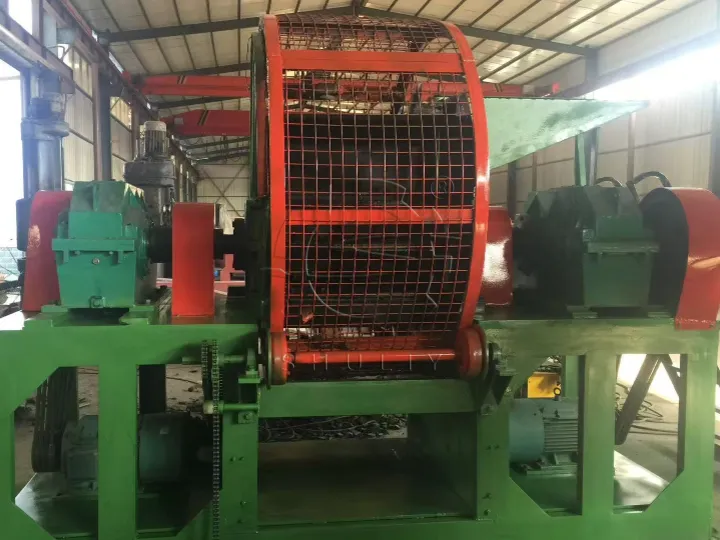
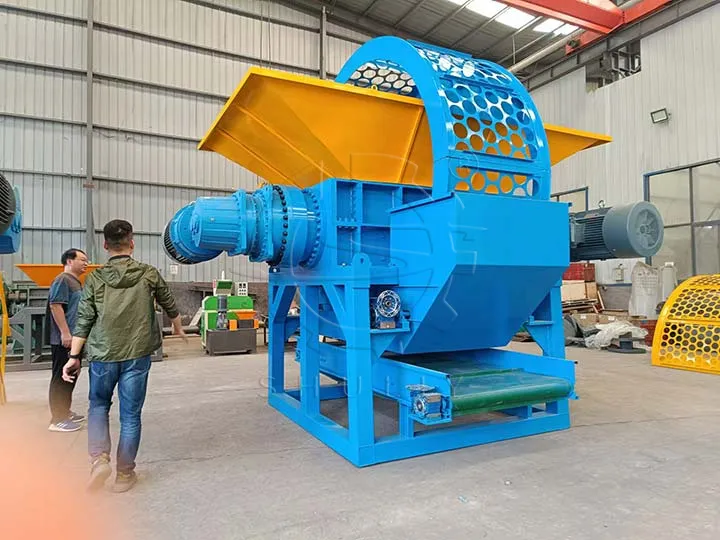
The prepared tires are fed into an industrial tire shredder. Its main function is to cut whole tires into smaller pieces, making the material easier to convey and process in subsequent stages.
The size of the output depends on the shredder design, blade configuration, and operating conditions. For scrap tire recycling projects, the primary shredder is an important machine because it handles the initial size reduction of bulky tires.
Step 3: Steel Wire Separation
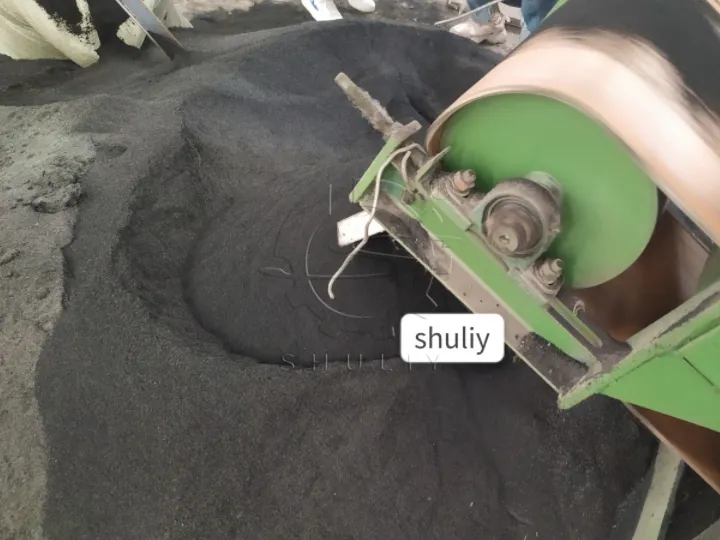
Scrap tires contain steel wire, especially in their bead and belt structures. Magnetic separation equipment is used to remove steel from the shredded rubber.
Separating steel helps improve the quality of the rubber material and allows the recovered metal to be collected as a separate recyclable product.
The separation arrangement may vary according to the shredder output size and the overall production line design.
Step 4: Rubber Granulation
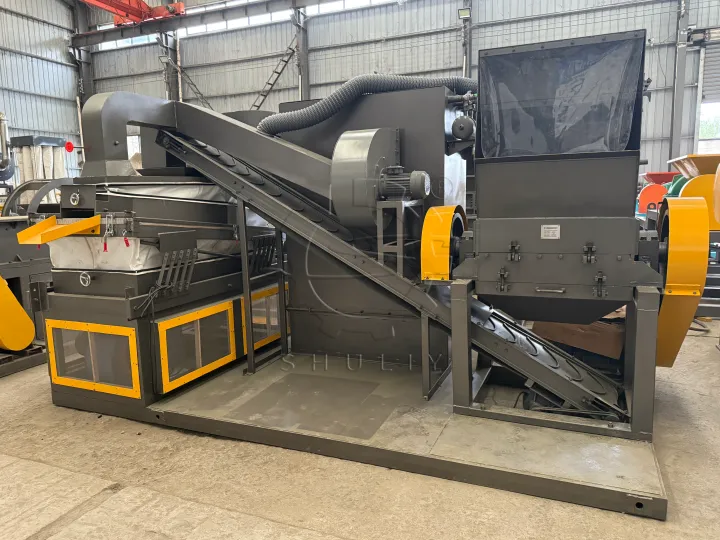
After primary shredding and preliminary steel separation, the rubber pieces enter a rubber granulator or other secondary size-reduction equipment.
This machine reduces the rubber into smaller particles. Different screen sizes and processing configurations can be used to obtain the required granule size.
In a complete scrap tire recycling system, the granulation stage plays a central role in determining the final product size and processing efficiency.
Step 5: Fiber Separation
Tire rubber contains textile fibers as well as steel. Fiber separation equipment uses airflow or other separation methods to remove lightweight fiber materials from rubber particles.
Effective fiber removal helps produce cleaner rubber granules. The required separation level depends on the intended application and the buyer’s quality specifications.
Step 6: Screening and Final Collection
The processed rubber is screened according to particle size. Oversized material can be returned for further grinding, while qualified granules are collected for storage, packaging, or sale.
A suitable screening system helps maintain consistent product size and reduces the amount of material that needs to be reprocessed.
3. What Equipment Is Needed for a Rubber Granule Production Line?
A complete production line may include:
- Tire debeader: Removes bead wire when required by the process.
- Tire cutter: Cuts de-beaded tires into appropriately sized pieces for shredder feeding.
- Tire shredder: Cuts whole tires into smaller pieces.
- Magnetic separator: Extracts steel wire from the rubber.
- Rubber granulator: Reduces rubber pieces into smaller granules.
- Fiber separator: Removes textile fibers.
- Vibrating screen: Sorts rubber particles by size.
- Conveyors: Transfer materials between processing stages.
Not every project requires exactly the same equipment. The configuration for scrap tire recycling should be based on the type of tires, target capacity, desired granule size, and required product cleanliness.
For example, a project processing pre-shredded tire chips may not need the same primary shredding equipment as a plant receiving whole tires.
4. What Affects the Quality of Recycled Rubber Granules?
The quality and market value of rubber granules depend on several factors.
Particle size: Different applications require different granule sizes. The grinding and screening system should match the customer’s specifications.
Steel content: Residual steel can affect product quality and downstream use. Appropriate magnetic separation is important.
Fiber content: Excessive textile fiber may reduce the suitability of rubber granules for certain applications. The separation system should be selected according to the required cleanliness.
Raw material condition: Tire types, wear conditions, and material composition can influence processing performance.
Equipment configuration: The machines must work together. Poorly matched equipment may cause bottlenecks, inconsistent particle sizes, or unnecessary material recirculation.
5. What Are Recycled Rubber Granules Used For?
Rubber granules recovered through scrap tire recycling can be used in various industries, depending on their size, cleanliness, and quality.
Common applications include:
- Rubber flooring and floor mats
- Sports tracks and athletic surfaces
- Playground safety surfaces
- Rubber tiles and molded rubber products
- Other rubber-based construction and industrial products
Before choosing a production line, it is important to identify the target market. Different customers may require different particle sizes and levels of steel and fiber removal.
6. How to Choose the Right Tire Recycling Line
When planning a rubber granule production project, consider these points before purchasing equipment:
- Raw material: Will you process passenger car tires, truck tires, or mixed waste tires?
- Production capacity: How many tons of tires do you plan to process per day?
- Final product: Do you need coarse rubber chips, rubber granules, or finer rubber powder?
- Product quality: What are the customer’s requirements for particle size, steel content, and fiber content?
- Available space: Does your workshop have enough room for the machines, conveyors, and material storage?
- Future expansion: Can the production line be expanded if your business grows?
A properly designed line should balance processing capacity, product quality, equipment investment, and operating requirements.
7. Build a Suitable Scrap Tire Recycling Solution with Shuliy
Turning waste tires into rubber granules requires more than a single machine. Each processing stage must be matched to the raw materials and the final product requirements.
Shuliy provides tire recycling equipment and production line solutions for different processing needs. Whether you plan to start with a small-scale project or establish a larger rubber granule plant, the equipment configuration should be based on your actual production goals.
To discuss a suitable scrap tire recycling solution, share the following information with our team:
- The types of waste tires you plan to process
- Your expected daily processing capacity
- The required rubber granule size
- Your available workshop space
- Your target market or end use
Our team can help you evaluate the appropriate equipment combination for your project.
Frequently Asked Questions
1. Can whole waste tires be directly made into rubber granules?
Whole tires generally need to pass through several processing stages, including shredding, steel separation, granulation, fiber removal, and screening. The exact process depends on the raw materials and final product requirements.
2. What is the difference between tire shredding and rubber granulation?
Tire shredding is the initial size-reduction stage, which turns whole tires into smaller pieces. Rubber granulation further reduces these pieces into smaller rubber particles.
3. How is steel removed from waste tires?
Steel is commonly removed using magnetic separators after the tires have been shredded. Some production lines also use a tire debeader to remove bead wire before shredding.
4. Can a tire recycling line produce different rubber granule sizes?
Yes. The final particle size can be adjusted through suitable grinding equipment and screening configurations. The required size range should be confirmed before selecting the machines.
5. What information is needed to get a tire recycling line quotation?
You should provide the tire types, expected processing capacity, required rubber granule size, and target product quality. Workshop dimensions and local power requirements are also useful for preparing a suitable proposal.