Across Africa, one quiet business opportunity is hiding in plain sight: every egg that reaches a market needs a tray, and most farms still buy those trays from someone else. As poultry populations boom — Tanzania alone went from 79 million birds in 2019 to over 113 million in 2025 — the gap between egg production and local packaging capacity keeps widening.
That gap is exactly where a small egg tray machine becomes a surprisingly profitable investment. This article walks through how one Tanzanian layer farmer turned his packaging problem into a side business, what he bought, what it cost to run, and what anyone considering the same move should know before placing an order.
Why Egg Trays Are a Business Worth Looking At
Before getting into the story, it helps to understand the market fundamentals. In most African countries, molded pulp egg trays are either imported or produced by a small number of large factories. This creates two problems for local farmers:
- Supply is unreliable. During peak laying seasons, distributors run out of trays and farms are forced to store eggs in whatever containers they can find.
- Quality is inconsistent. Thin, soft trays crack under stacking weight, which means more broken eggs and lower profits at the market.
An egg tray machine changes this equation completely. It converts waste paper — old newspapers, cartons, office scrap — into sturdy, uniform egg trays on demand. The raw material costs almost nothing, the process is simple to learn, and every poultry farm within driving distance becomes a potential customer.
For a farmer already in the egg business, producing your own trays is the closest thing to a “no-brainer” investment: you eliminate your own packaging cost first, then sell the surplus.
The Tanzanian Farmer Who Turned a Problem Into a Business
Our client runs a commercial layer farm in Tanzania. Like many mid-sized producers, he had reached the point where his daily egg output exceeded the number of trays his suppliers could reliably deliver. Some weeks he was turning away eggs because he had nothing to put them in.
He considered three options: keep buying from suppliers (unstable), import trays in bulk (expensive and slow), or buy his own egg tray machine and produce in-house. He chose the third option — and quickly realized he could produce more than he needed, opening a second revenue stream.
His farm had one advantage that many buyers ask about: a river runs alongside his property. His very first question was whether river water could feed the machine. The short answer is yes — with a settling tank and basic filtration to remove silt, river water works perfectly well in the pulping process, and the machine recirculates most of that water anyway.
Step 1: Choosing the Right Egg Tray Machine for a Small Operation
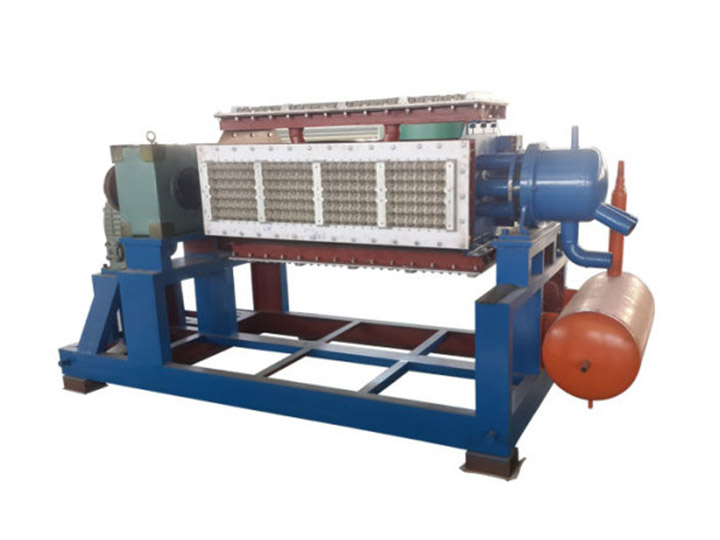
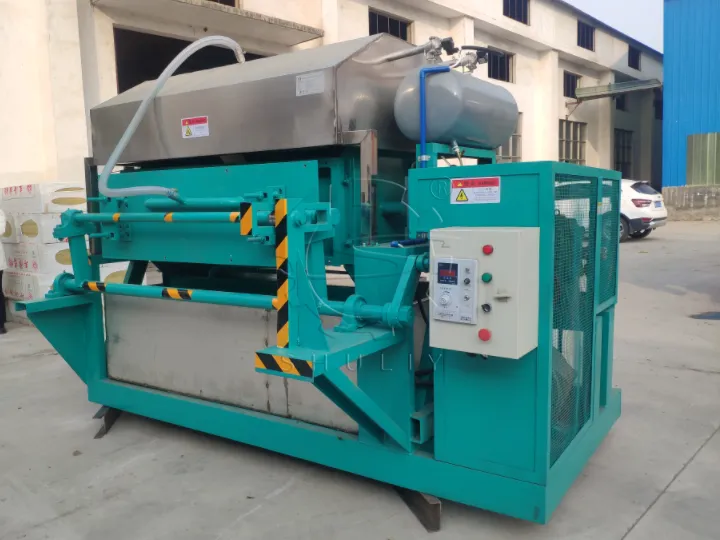
Not every egg tray machine fits every situation. For a first-time operator with a medium-sized farm, the sweet spot is usually a compact 3×1 configuration. Here is what “3×1” means in practice:
| Element | What It Means |
|---|---|
| 3 molds | The forming unit carries 3 egg-tray molds per cycle |
| 1 side | Single-side forming, simpler mechanics, lower price |
| Saída | Roughly 200–250 trays per hour, or 1,500–2,000 per 8-hour shift |
| Matéria-prima | Waste paper pulp |
| Poder | 3-phase electricity |
| Workers | 2–3 people after basic training |
This size is large enough to cover a commercial farm’s own needs and generate surplus for sale, yet small enough that the investment, floor space, and learning curve stay manageable. We sent the client a full set of mold drawings so he could see that the same machine can also produce egg cartons, fruit trays, and bottle carriers by changing molds — flexibility that matters once the core business is running.
Step 2: Solving the Drying Problem (The Part Most People Underestimate)
If there is one mistake new buyers make, it is underestimating how important drying is. Wet trays coming off the egg tray machine contain a lot of moisture, and they must be dried before they are rigid enough to use.
In a dry climate, you can dry trays on wire racks in the sun. In Tanzania’s tropical humidity — especially during the long rainy season — sun drying is unreliable. Trays take too long, may grow mold, and production stops whenever it rains.
Our client initially asked about coal-fired drying and wanted to compare fuel costs. After reviewing his climate and production volume, we recommended a drying chamber instead. A drying chamber circulates heated air through racks of wet trays, finishing them in hours rather than days. The client purchased a small transfer cart and 30 mesh drying racks to move trays in and out efficiently.
The drying chamber also shrinks the land requirement dramatically. Natural sun drying would have needed roughly 500 m² of open ground. The drying chamber fits inside the same 60–80 m² covered building that houses the pulper and former.
Step 3: Site, Power, and Water Setup
Getting the site right before the machine arrives saves weeks of delay. For a 3×1 egg tray machine, the minimum practical setup looks like this:
- Covered floor space: 60–80 m² for the pulper, forming machine, vacuum pump, and wet-tray handling area.
- Poder: 3-phase electricity. The vacuum pump and main motor cannot run on single-phase household current.
- Water: A settling tank + filter if using river or well water; the system recirculates water, so consumption is low.
- Drying: Either a drying chamber (recommended for humid climates) or a large open area for sun racks.
Our client sent photos and videos of his site so our engineers could confirm the layout, cable runs, and water inlet position before shipment. We also helped him obtain sea freight quotes to Dar es Salaam so he knew his total landed cost, not just the machine price.
Step 4: What the Complete Package Included
Rather than buying a standalone machine and figuring out the rest later, the client ordered a turnkey package:
- 3×1 egg tray forming machine
- Hydrapulper (waste paper → fiber slurry)
- Vacuum pump for mold filling and dewatering
- Drying chamber with heated-air circulation
- Transfer cart + 30 mesh drying racks
- Spare molds and mold drawings for 30-cell egg trays
- Installation guidance and operator training
This approach is almost always cheaper in the long run than sourcing components separately, because every part is sized to work together and the output is predictable from day one.
Cost and Profit: What the Numbers Look Like
A common question is whether a small egg tray machine actually makes money. Here is a realistic breakdown based on African operating conditions:
| Cost Item | Estimate |
|---|---|
| Waste paper (1 ton ≈ 14,000–16,000 trays) | $50–$100 |
| Water + electricity (per day) | $15–$30 |
| Labor (2–3 workers, per day) | $30–$60 |
| Production cost per tray | $0.007–$0.013 |
| Wholesale selling price per tray | $0.015–$0.030 |
At these numbers, the gross margin per tray is roughly 50% or more. Even if half the output is used on the farmer’s own farm (replacing trays he used to buy), the other half generates pure margin. Payback on a 3×1 setup is typically measured in months, not years — especially when you factor in the eggs saved from breakage by using stronger, properly dried trays.
Lessons From This Project
Three lessons stand out from this Tanzanian installation that apply to almost any African start-up:
- Do not skip the drying chamber in a humid climate. It is the difference between a reliable daily output and a business that stops every time it rains.
- River or well water is fine — just filter it. You do not need municipal water to run an egg tray machine.
- Buy a turnkey line, not a lone machine. Matching the pulper, vacuum pump, former, and dryer yourself usually costs more and produces less than a configured package.
Is an Egg Tray Machine Right for You?
An egg tray machine is a strong fit if you already run a poultry farm, distribute eggs, or have access to waste paper and local farms that need trays. It is a lower-risk entry into manufacturing than most businesses because the product is essential, the raw material is cheap, and the customer base is already there.
If you are evaluating this business, the first conversation should cover four things: your target daily output, the space and power you have available, your water source, and your climate (which determines the drying method). From there, a reputable supplier can recommend a configuration and give you a real total-cost picture.
Shuliy has delivered egg tray machines and complete pulp molding lines to over 50 countries, with multiple installations running in Tanzania and across East and West Africa. Every machine is factory-tested before shipping, and we support installation, training, and after-sales service. If you are ready to explore what an egg tray machine could do for your farm or business, send us your site details, and we will put together a proposal tailored to your goals.