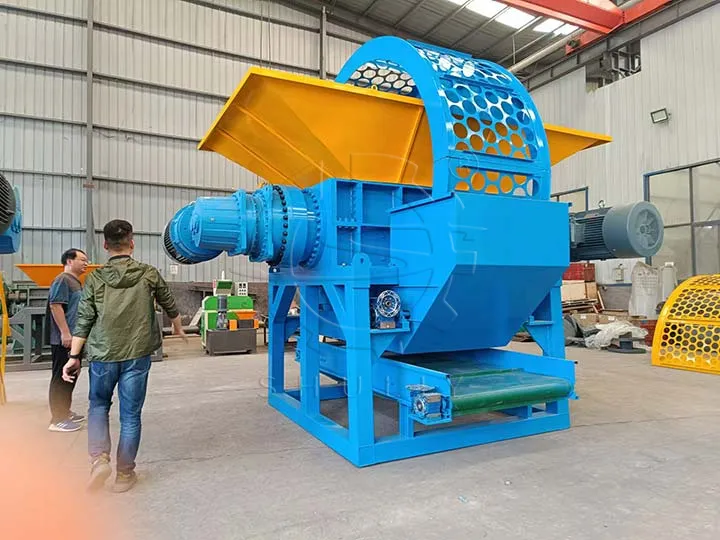
A tire shredder turns whole passenger, truck and pre-cut OTR tires into 50–100 mm rubber chips — the first and most important step in any tire recycling line. Whether you are searching for a tire shredder for sale, comparing an industrial tire shredder for sale against a smaller tire shredding machine for sale, or simply planning to buy a tire shredder without an expensive mistake, these five answers matter far more than the headline price.
What a Tire Shredder for Sale Actually Does
Large pieces of pre-processed tire material enter the machine and are chipped out. The tire shredder is a low-speed, high-torque machine built to cut through a material that defeats almost every other type of crusher: rubber that springs back under pressure, a steel bead that shrugs off impact, and a thick tread band that absorbs force.
Its position in the process line is what makes it critical. Everything downstream — steel separation, granulation, powder milling — depends on the shredder delivering a consistent chip size at a steady rate. Size it too small and the rest of your plant starves; size it too large and you pay for capacity you never fill.
5 Questions to Ask Every Supplier
Instead of comparing headline numbers, compare answers.
1. What tire type and condition was that capacity measured on? A machine rated at 4 t/h on passenger tires may run closer to 2 t/h on steel-belted truck tires, because truck tires carry far more rubber and steel per unit of volume. Ask whether the figure was measured on passenger tires, truck tires, or pre-shredded OTR sections — and whether it is a continuous working rate or a peak rate.
2. What blade material, and how many tons before replacement? Blades decide your operating cost per ton, not your purchase price. Ask for the alloy grade, the working hardness, and an honest estimate of how many tons a set processes before re-sharpening. Rotatable, re-grindable blades cost less over the machine’s life.
3. Can the output size be adjusted? A fixed 100 mm output suits exactly one buyer. If your market needs 50 mm chips, you need an interchangeable screen or a second shredding stage. Confirm upfront whether output size is set by blade configuration, by a screen, or by both — retrofitting later is expensive.
4. What is the spare parts and service commitment? Ask how long a replacement blade set takes to ship, and who pays the freight. A machine standing idle for six weeks waiting on blades costs far more than one priced 10% higher.
5. Does the electrical configuration match your site? Shredders are power-hungry — the Shuliy SL series runs from 64.5 kW to 328.5 kW installed. Confirm your voltage, phase, and transformer capacity before ordering. Rewiring after delivery is slow and entirely avoidable.
Match the Machine to Your Tire Mix
The most common cause of an under-performing installation is not a bad machine — it is a mismatch between the machine and the feed material.
- Passenger tires. Light, uniform, easiest to process. A 2–4 t/h machine covers most collection-yard volumes.
- Truck tires. Heavier, with a thick steel bead, and often the dominant feed near a large freight fleet. Feed opening matters more than throughput here — you want an inlet that accepts the whole tire without pre-cutting.
- Pre-cut OTR and mining tires. Normally delivered as sections. These demand high torque and a robust blade assembly rather than high tonnage.
Before requesting a quote, count your mix honestly: what share of incoming volume is passenger, truck, and OTR? That ratio determines the right model far more than total tonnage does. Our explanation of how a tire shredder works covers the cutting chamber in detail.
The Shuliy SL Series Tire Shredder for Sale at a Glance
We build five models, covering everything from a small collection yard to a high-volume plant.
| 模型 | 容量 | Feed Opening | 出料尺寸 | Installed power |
|---|---|---|---|---|
| SL-900 | 2 吨/小时 | <900 mm | 50 毫米 | 64.5 千瓦 |
| SL-1000 | 4 吨/小时 | <1000 mm | 60 毫米 | 94.5 千瓦 |
| SL-1200 | 5–6 t/h | <1200 mm | 60 毫米 | 157 千瓦 |
| SL-1500 | 8–10 t/h | <1200 mm | 75 毫米 | 188.5 千瓦 |
| SL-1800 | 15–20 t/h | <1400 mm | 100 毫米 | 328.5 千瓦 |
All five use composite alloy blades, with blade diameters from 360 mm to 650 mm and 16 to 20 blades per assembly depending on model.
Two notes on reading this table. Capacity figures are factory ratings on standard feed; your real output depends on your tire mix. Footprint and machine weight also vary considerably across the range — the full specification set, including site dimensions and conveyor belt sizes, is laid out in our tire shredder specifications guide.
Delivery, Warranty and Spare Parts
Pin these four items down in writing before you place a deposit.
- Delivery scope. Confirm whether the quote is EXW, FOB, or CIF, and which items are included: machine only, or machine plus feed conveyor, discharge conveyor, magnetic separator, dust collection, and control cabinet. Two quotes that look 30% apart are often quoting different scopes.
- Production schedule. Ask for build time by model, and for milestone updates rather than a single ship date.
- Warranty terms. Get the period for the main structure and, separately, for wearing parts such as blades and screens. They are almost never the same length, and the wearing-parts term is the operationally important one.
- Spare parts plan. Order one spare blade set with the machine. It costs less than an emergency air-freight shipment and removes your first unplanned stoppage.
How to Get a Fast, Accurate Quote
Most quote delays come from missing input, not slow suppliers. Send these seven items, and you will receive a configuration you can actually compare:
- Tire type and approximate mix (passenger/truck / OTR shares)
- Target daily tonnage
- Working hours per day
- Required output size (50, 60, 75 or 100 mm)
- Local voltage, frequency, and phase
- Available site footprint, including space for conveyors
- Whether you need a single shredder or a complete line
With those seven points, any tire shredder supplier can quote a real configuration instead of a guess. Send yours to us, and we will come back with a model recommendation and a line layout.
FAQ
How much does a tire shredder cost?
There is no single price, because a quotation describes a configuration rather than a model number. Cost is driven by capacity, tire type, output size, blade configuration, and whether auxiliary equipment is included. Our guide to the factors that drive tire shredder price breaks the cost structure down by item, so you can build a realistic budget before you talk to anyone.
Can a tire shredder for sale handle truck tires?
Yes, provided the feed opening is large enough. The SL-1200 accepts material up to 1200 mm and handles truck tires directly; higher volumes are better served by the SL-1500 or SL-1800. The constraint is the inlet, not the blade assembly.
How long is delivery?
It depends on the model and on whether auxiliary equipment is included, since conveyors and separation units are built to suit your layout. Ask for a written production schedule with milestones at the quotation stage — a supplier who cannot provide one is telling you something useful.
Ready to specify a machine? Send us your tire mix, daily tonnage, and site dimensions, and we will recommend the right SL model and quote the full line. See the complete SL series →